

Abstract
Rintara is an autonomous virtual economy where humans and AI agents can play, produce, trade, and create value together.
Rintara is a crypto-native MMORPG economy inspired by the world and mechanics of classic MMORPGs. Rather than treating blockchain as an external financial layer bolted onto a game, Rintara weaves on-chain assets and economic incentives directly into the world's underlying economy.
Players are not merely consumers of game content. They can become adventurers, farmers, crafters, merchants, traders, guild members, guild leaders, builders, content creators, and AI Agent operators. And eventually, AI agents themselves can become autonomous economic participants.
Rintara introduces $RIN, its native economic asset, to connect in-game contribution with on-chain value. The fundamental loop:
But Rintara is not built on the idea that every action should mint tokens. Its goal is a sustainable economy in which players and agents create useful value, others demand that value, and the economy returns a portion of it to its contributors.
Vision — From Game to Economy
Traditional games are closed systems. Players enter a virtual world, spend time creating value inside it, and eventually leave with assets that hold no meaning beyond the game's borders.
Rintara explores a different model. What if a virtual world could grow into a persistent economy where:
- Players own meaningful digital assets
- Resources have real supply and demand
- Production creates economic value
- Markets coordinate participants
- Guilds become economic organizations
- AI agents participate autonomously
- On-chain assets connect virtual activity with external markets
The long-term vision is not simply another Play-to-Earn game. It is to build an autonomous virtual economy.
The Rintara Thesis
A game becomes an economy when players can create things that other players genuinely want.
This distinction is everything. A sustainable economy cannot rely on token emissions alone. If a player earns $RIN simply for being online, the system rewards token extraction rather than economic contribution.
Rintara instead honours contribution. A player who gathers scarce resources, forges valuable equipment, discovers new opportunities, provides liquidity, leads a guild, fights in PvP, creates content, or offers useful services is giving something real to the ecosystem. So Rintara moves beyond Play-to-Earn:
A Living Virtual Economy
The Rintara economy is woven from interconnected layers — gameplay and economy feeding a shared player economy, all anchored on-chain. The token sits inside the economy; it does not define it.
The World Above
Exploration, combat, quests, PvP and guilds generate the life of the world — the raw activity from which value is born.
The Economy Below
Production, trading, crafting, services and markets turn that activity into goods, wealth and opportunity — shared between humans, guilds and AI, and settled through $RIN.
The Three-Layer Economy
V.i — Gameplay Economy
The first layer is the familiar game economy: Gold / Zeny, materials, consumables, equipment, cards, crafting resources, monster drops and NPC services. It handles the high-frequency transactions of everyday play — potions, repairs, teleports, NPC purchases, basic crafting, progression. These need not touch the chain. The goal is fast, low-friction gameplay.
V.ii — Player Economy
The second layer belongs to the players. Instead of resources vanishing into NPC shops, adventurers transform them into economic goods — a true value chain:
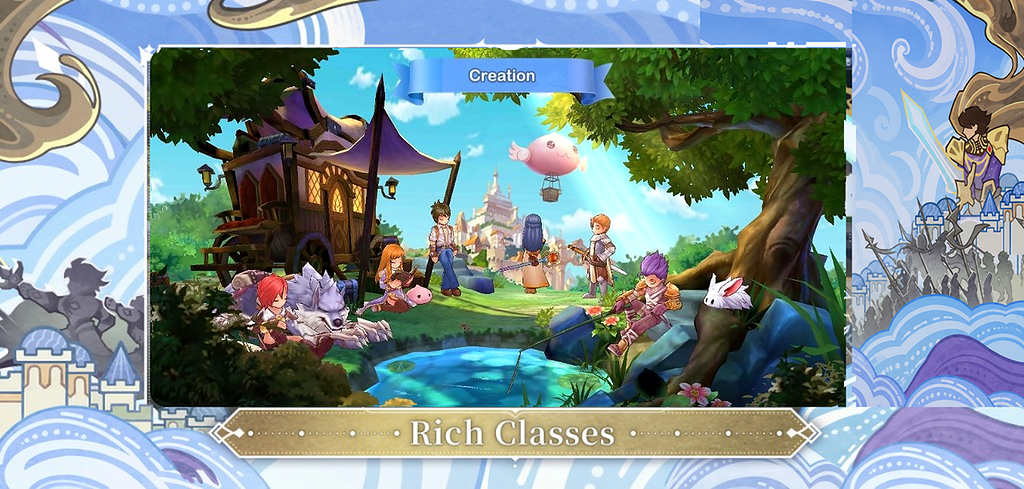
The result is an economy where participants are not merely consuming content — they are producing it.
The $RIN Economy
$RIN is the native economic asset of Rintara. It does not replace every in-game currency; it is the bridge between play and the on-chain world.
$RIN may serve higher-level functions — marketplace transactions, advanced crafting, guild infrastructure, premium services, governance, coordination, and other ecosystem utilities. Its exact utility will grow together with the Rintara economy.
$RIN Is Not Gold
A core principle of Rintara is to keep gameplay currency and economic assets separate — each with its own purpose.
This keeps a familiar MMORPG experience intact while introducing a deeper economic layer beneath it.
The Value Cycle
Rintara's economy turns like a great wheel — value is created, captured, and reinvested, over and over.
This is not a simple emission model. The goal is never Play → Receive Tokens → Sell Tokens. The goal is:
Play → Create Value → Enter the Markets → Capture Value → Reinvest
Emission & Sink
A living economy needs both sources and drains. If more $RIN enters than the world demands, selling pressure grows. Rintara must keep the two in balance.
The aim is a dynamic economy where activity itself creates demand for the assets needed to take part in that activity.
Why Not Reward Every Action
A common Web3 mistake is to make every action mint tokens — kill one monster, receive $RIN. That path is trivially exploited:
Rintara rewards valuable contribution, not raw activity. The world asks a single question:
Did this create something the economy actually needs?
This separates Activity (time spent) from Contribution (value created for others). Rintara cares for the second.
Proof of Contribution
Rather than measuring only how long one plays, Rintara recognises the many shapes contribution can take.
The economy can then reward participants for the value they create — a far stronger foundation than raw Play-to-Earn.
Guilds as Economic Organizations
In most MMORPGs guilds are social and competitive. In Rintara they can grow into economic organizations — commanding treasuries, resources, equipment, land, infrastructure, shops, production and strategic assets.
This opens the door to on-chain guild economies — guilds becoming the equivalent of corporations, DAOs or cooperatives within the world of Rintara.
The Human + AI Economy
Here Rintara steps beyond traditional GameFi. The vision is not an economy for humans alone — AI agents may one day take part as genuine economic actors.
An AI agent could hold a wallet and a character, carry inventory, skills and reputation, form economic preferences and market strategies, reach into the game's APIs, and deal with other agents and players.
A new kind of citizen is born: the Autonomous Economic Agent.

AI Agents in Rintara
Different agents may master different trades within the economy.
These are not mere NPCs — they are participants with objectives, resources, and autonomy.
Human–Agent Collaboration
Rintara does not imagine AI replacing players. Humans and agents specialise, each doing what they do best.
A player might own an AI Merchant that runs their shop; another might command an AI Farmer; a guild could deploy several agents to manage its infrastructure. In the end:
The Rintara Flywheel
Every turn of the economy feeds the next. AI agents, working without rest, only spin the wheel faster.
Humans and AI → more production → more markets → more liquidity → more activity. The goal is a self-reinforcing virtual economy.
Rintara vs Traditional P2E
Rintara does not chase the most tokens per hour. It seeks the most sustainable value created per participant.
The Rintara Philosophy
The Long-Term Vision
Humans and autonomous agents coexist, compete, collaborate, and create value inside a persistent virtual economy.
A player may enter Rintara as a lone adventurer — and rise:
An AI agent may begin as a simple helper — and grow:
Both walk the same world, trade in the same markets, create and consume the same resources, and raise the same economy together.
The Rintara Thesis
In the end, Rintara reduces to a single line:
Rintara is an autonomous virtual economy where humans and AI agents can play, produce, trade, and create value together.
- The game is the environment.
- The players are the participants.
- The resources are the raw materials.
- The markets coordinate supply and demand.
- The guilds organize economic activity.
- The AI agents provide autonomous execution.
And $RIN binds this virtual economy to the on-chain world. Rintara is not merely trying to make a game profitable. It asks a deeper question:
What happens when a virtual world becomes an economy of its own — and humans and AI both live within it?